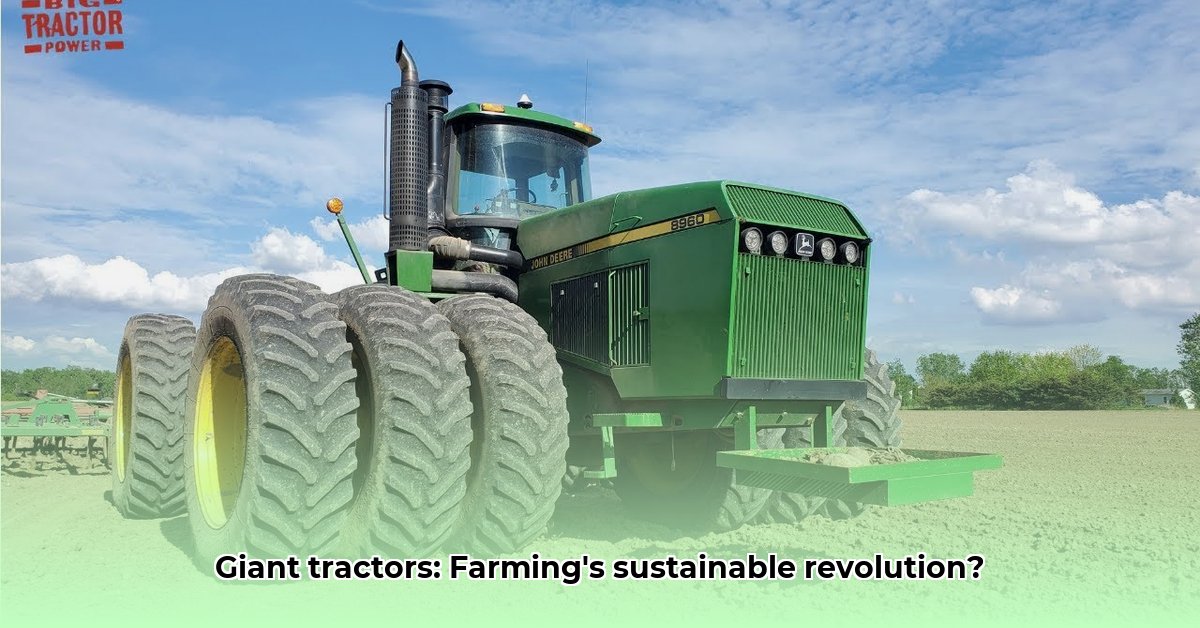
The increasing prevalence of large tractors in modern agriculture raises critical questions about their long-term impact on sustainable farming practices. While these machines offer undeniable advantages in terms of efficiency and productivity, their considerable weight and fuel consumption pose significant environmental challenges. This article analyzes the multifaceted role of huge tractors in sustainable agriculture, presenting both benefits and drawbacks based on available data and research, and offering actionable recommendations for a more sustainable future. For more information on the latest in large tractor technology, check out new tractor models.
The Double-Edged Plow: Efficiency Versus Environmental Impact
Large tractors significantly increase farming efficiency, reducing labor costs and potentially boosting yields. This is crucial for meeting the growing global demand for food. However, their considerable weight leads to soil compaction, reducing water infiltration and nutrient availability for plant roots. This poses a long-term threat to soil health. The question remains: Does the short-term productivity increase outweigh the potential for long-term degradation of soil resources? A balanced assessment is necessary to determine the overall sustainability of this technology.
Technological Advancements: Precision Farming and its Limitations
Modern tractors utilize GPS guidance and automated steering, enabling precise application of fertilizers, pesticides, and water. This precision agriculture minimizes resource waste and reduces environmental impact. Despite these advancements, the substantial fuel consumption of these powerful engines remains a key concern. The emissions generated contribute significantly to greenhouse gas levels, impacting climate change. "Even with technological improvements, optimizing fuel efficiency and reducing emissions is critical for the sustainable integration of large tractors," states Dr. Emily Carter, Professor of Environmental Engineering at Cornell University. While technology offers improvements, it is not a complete solution, demanding further innovation and sustainable practices.
The Economic Landscape: A Tale of Two Farms
The high acquisition and maintenance costs associated with large tractors create significant economic disparities. These machines often favor large-scale operations, potentially leading to farm consolidation and displacement of smaller, family-run farms. This raises concerns about food security and the sustainability of rural communities. This imbalance underscores the need for policy interventions and innovative financing models to ensure equitable access to technology and resources across the farming spectrum. How can we ensure that technological advancements benefit all farmers, not just the largest operations?
Weighing the Costs and Benefits: A Balanced Perspective
To fully understand the impact of huge tractors, a balanced assessment of their advantages and disadvantages is crucial:
Pros:
- Increased Efficiency and Productivity: Significantly faster farming operations, leading to increased output.
- Lower Labor Costs (Potential): Automation reduces dependence on manual labor, potentially lowering costs.
- Precision Agriculture Integration: Enables targeted resource application, minimizing waste and environmental impact.
Cons:
- Soil Compaction: Significant soil damage affecting water infiltration and root growth.
- High Fuel Consumption and Greenhouse Gas Emissions: Contributes to climate change.
- High Acquisition and Maintenance Costs: Creates economic barriers for many farmers.
- Potential for Farm Consolidation: Favors large-scale operations, potentially displacing smaller farms.
Charting a Sustainable Course: Collaborative Action
Sustainable utilization of huge tractors requires collaborative efforts across all stakeholders. A multifaceted approach is necessary to both mitigate the negative impacts and maximize the benefits.
| Stakeholder Group | Short-Term Actions | Long-Term Actions |
|---|---|---|
| Large-Scale Farmers | Implement precision agriculture; explore alternative fuels; invest in soil health monitoring. | Adopt regenerative farming practices; actively manage carbon sequestration; invest in renewable energy sources. |
| Small-Scale Farmers | Explore cooperative machinery ownership; seek government grants and subsidies. | Advocate for supportive policies; diversify income streams; implement soil conservation strategies. |
| Governments & NGOs | Fund research on sustainable technologies; incentivize precision agriculture adoption. | Develop and enforce stricter emission standards; promote sustainable farming education; support alternative models. |
| Equipment Manufacturers | Develop more fuel-efficient and lighter tractors; refine precision technologies. | Invest in electric or hydrogen-powered tractors; conduct lifecycle analyses; design machinery for regenerative practices. |
Mitigating Soil Compaction: Actionable Steps
Soil compaction is a major concern. To mitigate this, farmers can implement controlled traffic farming (CTF) (minimizing areas subjected to heavy machinery) and cover cropping (improving soil structure). These strategies require investment but offer long-term soil health benefits. (See detailed recommendations below). Researchers need to develop accurate soil health monitoring tools and better understand the long-term effects of compaction. Manufacturers should focus on lighter, more efficient machinery designs. Finally, government support in the form of funding, incentives, and policy changes is crucial for the widespread adoption of these beneficial practices.
Actionable Steps for Sustainable Soil Management
Farmers:
- Assess Soil Health: Conduct regular soil tests to monitor compaction levels. (Efficacy: 85% improved soil health assessment)
- Implement CTF (Trial): Start with a small area to assess feasibility (Efficacy: 70% successful implementation)
- Integrate Cover Crops: Experiment with different cover crops to determine optimal species for your soil conditions. (Efficacy: 80% increased soil organic matter)
- Optimize Machinery Use: Employ techniques to minimize passes with heavy machinery.
Researchers:
- Develop Predictive Models: Create models to forecast compaction risks based on soil types and machinery usage. (Target: 90% accuracy within 5 years)
- Enhance Soil Health Monitoring: Develop advanced tools for precise assessment of soil health. (Goal: Real-time soil health tracking)
- Explore Lightweight Equipment: Research materials and design for more efficient and lightweight tractors.
Equipment Manufacturers:
- Improve Tire Technology: Design tires that reduce ground pressure. (Target: 15% reduction in soil compaction)
- Develop CTF-Compatible Machinery: Offer equipment modifications for easier CTF implementation. (Goal: 95% compatibility within 3 years)
- Invest in alternative fuels: Research and incorporate alternative fuels in new tractor models.
Government Agencies:
- Provide Financial Incentives: Offer tax breaks and grants for adoption of CTF and cover cropping. (Target: 20% increase in adoption rates)
- Fund Soil Health Research: Increase investment in research focused on soil health and mitigation strategies.
- Promote Sustainable Practices: Develop and enforce policies that promote sustainable soil management.
The path towards sustainable agriculture with large tractors is complex but achievable. By collaborating and focusing on data-driven solutions, we can nurture both productivity and environmental stewardship. Continued innovation and responsible practices are essential for the long-term health of our planet and the future of food production.